Thursday, November 18, 2010

November/December Books

Brief Wondrous Life of Oscar Wao: Junot Diaz
Really effective, surprising and engaging book that I just loved. Turns the tired tropes of the first-generation immigrant narrative on their heads with humor and grace, and is a pure pleasure to read. This, the multigenerational story of an Dominican family surviving the dictatorship of Trujillo, then the new traumas of immigration and family dynamics. Overflowing, at times overwhelming, with its sex and violence, but never gratuitously. Can't recommend this one highly enough. And so good it got me to re-read...

Drown: Junot Diaz
Yeah, amazing short stories by Diaz, some better than others, but still an amazing short story collection about Dominican families in New York and New Jersey.
Goodbye Columbus:

The Human Stain - Philip Roth
Yep, the Philip Roth kick continues ever onward. I found this dragged a little more than American Pastoral which I read last month, although I still enjoyed it. The more Roth I read though, the more his own unhappiness, bitterness and misogyny starts to leak through. Still, an interesting study of identity, identity politics, sexuality, academia and the second half of the twentieth century.

Goodbye Columbus - Philip Roth
After the few darker Roth novels I read this year, this love story novella was a breath of fresh air. Capturing the conflicts of class and the confines of the era's conformity (1950's/60's America), this was a wonderful adolescent love story of passion and heartbrake. Star-crossed lovers I suppose, but not a tragedy in the classic sense. Surprisingly sweet for Mr. Roth, but I suppose it was his first book...

Portnoy's Complaint - Philip Roth
Are we sensing a theme this fall?
Okay, so I really enjoyed this, and found it fascinating as it is so damn famous, and wow, there really is a lot of masturbation in this book. Funny probably to read it so late after publication, and I can understand its impact at the time, and though hilarious at times, it didn't do a ton for me reading it now. In fact, it kind of made me feel icky in the way that reading Bret Easton Ellis will make me feel like taking a shower in bleach after I read one of his books. Further, it really continued to reveal to me the depths of Roth's bitterness and anger toward the world. My thought process "Wow, he really hates shiksa women... oh, I guess actually he just really hates women in general and is a misogynist... oh, now I can see that he just really really hates people."

Shopclass as Soulcraft - Matthew Crawford
A meditation/manifesto on the value of certain manual labor- craftsmanship to be most specific, over being an intellectual or physical cog in the larger production/consumption machine. Crawford himself is a PhD who became a motorcycle mechanic, and speaks of the joys, creative stimulation and good income that comes from craftsmanship, not to mention the self-esteem and self-efficacyt that emerges from problem solving work. Sure, he gets a little moralistic and rigid at times, but overall a solid critique of what we currently call capitalism and its soul-destroying nature in the American corporate version of it. In a lot of ways, he's speaking to and for the very same ideology of a book like "Fight Club," just in a less angry voice, and without the more problematic gender politics of that book. I'd highly recommend this to anyone in education, or in mental health for that matter, as it does tell us something about why our world as we know it is so unsatisfying.

Sway- Ori & Rahm Brafman
Yep -the standard book I love to read, pop social psychology stuff. However, this one had two sections I would recommend be mandatory reading for anyone becoming a therapist- one on theories behind the bullshit rise in bipolar diagnosis (and not a corresponding rise in suicide and bipolar behaviors at the epidemiological level) and another on the depressing/fascinating neurobiology of greed- yep, making money gives people the same rush in the reward centers of the brain as cocaine, and leads to similarly immoral behavior. And we wonder why ethics crumble in the face of money...


The Invisible Gorilla: Christopher Chabris and Daniel Simons
Do people know about the Invisible Gorilla study? Now a classic of psych 101 (but not when I took it 15 years ago!). Amazing experiment about attention, "inattentional blindness" and how we are deceived by perception. The book covers that, and then branches out into more generally how to not draw conclusions from data. It would be great for an intro psych course, also explaining why recent grads of med school overdiagnose pathologies (pay attention fellow early career shrinks!), explains the most egregious attribution errors in scientific research and how we stumble into them and how to avoid such pitfalls of trusting intuition over hard-headed analysis, and takes a few swpes at malcolm gladwell along the way. Anyone teaching psych 101 or with a passing interest in psychology, check this one out.

The Dharma Bums: Jack Kerouac

So, I'm revisiting a lot of books I should have read while in college, when I... had some different priorities. The point is, I'm a little older and wiser now than at the peak time I probably would have enjoyed some books more. Which is to say- although there was a lot to like about The Dharma Bums, its sort of a fundamentally adolescent book, and although there is nothing wrong with that, I just would have liked it more when I was younger or in a different place in my life. Would I recommend it? Yes, but more as a document/artifact that a pleasure read or anything enlightening about Buddhism or as literature. All told though, it was a fun read, and I do understand why its so beloved.

The Mindful Path to Self-Compassion: Christopher Germer


* * * * *
When I was in grad school for psychology, I very nearly wrote my dissertation on the history of self-help books, before writing about meditation with kids and teens. (a much better choice) I still have a place in my heart for self-help books, crappy and otherwise, and their anthropological value. I went crazy with some recent classics not so much in the self-help, but self-improvement realm recently:

How to Win Friends and Influence People - Dale Carnegie

Um, wow- I get why this is a classic. Its really really good and helpful tips on succesfully living in the world of people, whether you are a business person or parent or just someone who has to interact with people. Also unrelentingly positive, and articulates so many basic principles from Ancient Eastern and Western thought, or that could easily be articulated in today's positive psychology. Good stuff. I'm going to start throwing it a my shy and anxious patients.

48 Laws of Power - David Greene
Hot on the heals of Dale Carnegie I decided to check out the polar opposite self-improvement book, partly out of sheer anthropological curiousity about this Machiavellian update and apparent hip-hop bible. Verdict? This book is seriously godawful, not because of the amorality, but the atrociously hammy writing, and embarrassingly, hilariously enormous oversights where it directly contradicts itself (ie, court attention at all costs- any publicity is good publicity, and guard your reputation its priceless). Anyway, again, why did I read this? I guess it was a moderately amusing glimpse of what second-rate wanna-be MBA types fancy to be intellectual reading and keep prominently on their faux-mahoganey shelves. I kept imagining the Christopher Moltisanti's lackeys from the Sopranos.

How to Make People Like You in 90 Seconds or Less- Nicholas Boothman
Yet another book in the self-improvement anthropological study this month, this one an apparent classic in the annals of "neuro-linguistic-programming." Kind of ridiculous in its purported science of following people's speech, body language and other preferences to communicate more effectively, it was kind of interesting, if kind of bullshit. It is however, a great title for a book.

10 Qualities of Charismatic People: Tony Alessandro
Yeah, I don't know, really just more of the same as these other three books above...

Tuesday, September 14, 2010

September/October Books

Wow, I don't know what's happened to my attention span lately, but I was unable to finish no less than three books in the past few months- very unlike me. It also shows either a decreasing attention span, or perhaps an increasing maturity that I no longer put up with books that bore me. The first was "The Black Swan" (no, not the basis Aaronovsky movie) the non-fiction by Nicholas Nasir Taleb- the thesis of which is that big, history changing events are basically unpredictable, and we try to explain them in hindsight, but this is pointless. Well, okay, but I'm not sure how we can stretch that out to an entire book Mr. Taleb, besides citing examples like the recent market crash or 9/11 over and over again, and saying that these things are unpredictable, but somehow you can predict them- either as a high priced consultant or for the price of a hardcover book. The other I just couldnt get into (sorry Aaron), was the sci-fi contemporary classic Spin, by Robert Charles Wilson. I get Sci-Fi, I like sci-fi, I appreciate that it creates a space for interesting ideas to test themselves and play out against a backdrop of the implausable or inconceivable, but I just didnt feel like I was seeing anything new or any important confirmation about human nature that I didnt see beforehand, which is why I read literature. So what have I read recently? Also finished though kinda hated (mostly out of boredom) "A New Earth" by Eckhart Tolle. I was just bored, bored, bored and then annoyed- and this from a guy reads a LOT of self-help books and can usually understand what people find appealing about them.

Ranting aside, some things I did like in recent months:

Surviving the Dragon: Arjia Rinpoche
Fascinating, depressing look at Tibet during the cultural revolution as the communists seized power and sent in the red brigades to overthrow the existing order through attempting to erase culture, torture individuals to testify against each other and generally begin the cultural and literal genocide against the Tibetan people and culture. The book is written by a lama who became a collaborator with the Chinese, then fled from Tibet to tell his story. Really well worth reading for anyone with an interest in the Tibet issue or even just 20th century China.

Switch - Chip & Dan Heath
Very cool book about affecting behavior change on the individual and group levels. I have no idea why these kinds of pop sociology/social psychology books fascinate me lately, but they do. A great shout-out to my family friend Jerry Sternin also made this fun, as well as a unique explanation of solution-focused therapy and how it operates. Metaphors used throughout are easy to understand, and many I actually have already integrated into my work as a therapist - like "the elephant and the rider" as short term decision making vs. long term decision making, and how to fool yourself into better behavior (ie, saving money, eating healthy, etc). In the end, they also nicely explain that you cant force behavior change, but there are factors that are the same in all behavior change- looking for exceptions to the rule/problem, building those, making it as easy as possibly systemically for change, enlisting the "primitive brain" in helping us, etc. And, in January, you can actually read some applications that inspired me from this book in an article about sticking with new years resolutions that I will be quoted in in Good Housekeeping.

Freedom- Jonathon Franzen

As my friend Dan succinctly put it in his gmail status: Corrections > Freedom > Most Books. That about sums it up. I thoroughly, thoroughly enjoyed this book, was reading it before work even. Sentence for sentence, it was perhaps better written than The Corrections. That said, I did feel it covered a whole lot of territory that The Corrections (possibly my favorite book ever) didn't cover, and was not quite as fun or efficient. The intertwined plots each went on slightly too long, as did the book as a whole, and I never laughed aloud as I did with The Corrections. The tone veered from mild satire into a Tom Wolfe-esque bizarre narrative devices, which also felt tonally inconsistent in spite of some unforgettable lines and poignantly revealing and truthful moments that hit like a punch in the gut. All told, I'd still highly recommend for a balance of pleasurable and thought provoking.

American Pastoral - Phillip Roth
This was recommended highly by Dan after we were discussing Freedom, as another upper-middle-class American family angst drama, and it is one I've been meaning to read for a long time. And yes, it was good, really good- well written, nuanced, terrifying, hilarious, many things, but somehow didnt quite capture my interest in quite the way that Freedom did, even as it explored similar themes. Still, a truly great book, much deserving of its excellent reputation and praise.

Palestine -Joe Sacco
Wow, friend Ben O recommended this, as a pure example of the amazing things that one CAN do with a comic/cartoon. Its a graphic novel travel memoir of his time in Palestine in the early 90's and offers some really interesting perspectives on the Palestine/Israel issue and history and complexity on both sides that rarely gets explored in the tiny narratives that we encounter in the media. Depressing, to be sure, but I'd still highly recommend this for a more human-scale understanding of the issue. And although critics fault him for examining only one perspective, I like that as Sacco himself points out he's not trying to tell two sides, he just is presenting one.

The Accidental Billionaires- Ben Mezrich
As Ben B points out "Oh, Ben Mezrich is writing another book about overprivileged Ivy-leaguers behaving badly?" Well, yes. This is the book that The Social Network movie was based on, and true to Mezrich's form, its both entertaining and impossible to put down, in spite of the fact that the writing is atrociously littered with hyperbole and cliche. Still, a fun read if you want a little more backstory on the lurid history of Facebook.

Bonk - Mary Roach
Sorta ended up being exactly what I expected and thus wasnt exactly "disappointed" because I had such low expectations. A snarkily written, double-entendre ridden pop history of sex and science from ancient times through the present. Some great anecdotes and fun facts to be sure, but ultimately even a topic like this one didn't have quite enough going for it to keep the irritating writing at bay.

The Devil and Sherlock Holmes - David Grann
Okay, so basically this is just a compilation of his articles from the New Yorker for the past few years, and capitalizing on the success of Lost City of Z and the infamous story about the Texas death penalty arson case. And I've read all these pieces before, but damn I forgot what a phenomenal writer he is and that he's written many of my favorite pieces in recent memory- the giant squid piece, the Aryan brotherhood piece, the French con man who pretends to be a missing child in Texas, and the crazy Polish novelist-murderer piece. Yeah this is good stuff, even on a second read. What makes the New Yorker great, and an heir to the great writing of William Finnegan.

Also fewer books this month in part due to my recent obsession with listening to Marc Maron's WTF podcast which I highly recommend. (And yes, I also finally caved in and started listening to Radiolab, allowing the quality of its substance to generally overriding its extremely irritating stlye) Favorite captivating recent episodes of WTF include Louis CK, Judd Apatow, Maz Jobrani, Adam McKay, and Maria Bamford, and. Other ones with big stars are also really interesting- Robin Williams, Ben Stiller and others. I'd highly recommend it for anyone with an interest in the creative process, as its instructive and fun to hear about the creative process (and unbelievably hard work) of so many interesting talented people, and a pleasure to briefly feel like an insider in the crazy world of standup comedy. PLus Marc Maron is a great character himself, a recovering alcoholic whose resentments, insecurities and neurosis frame each interview while also leaking into and informing them, and in a self-aware but not self-pitying way.

Wednesday, September 1, 2010

More Recently Read and Reviewed Books: June Through August

Connected - James Fowler and Nicholas Christiakis
Amazing pop-social-psychology book about the power of social networks (no, just just online social networks) and the ways behaviors and health issues like obesity and smoking are essentially contagious, and full of fun facts like that if one person two degrees of separation away from your circle of friends quits smoking, you are more likely to, etc. Also cites those research studies about longevity and social life, happiness and social life. There are also great and fascinating pieces that are relevant to anyone in public health or thinking about marketing and even voting and activism.

Click - The Magic of Instant Connections
A little bit along the same lines as “Connected,” and a lot about the power of social forces in shaping us, and the influence that we can have in shaping social experiences. A lot about what makes people get along and ally with each other (proximity, exposure, environment, vulnerability etc- surprise, surprise), but some fun ideas about how to build effective teams and in-groups and practical thoughts for relationships in business, medicine, teaching, psychotherapy, and even dating.

Empire of Blue Water - Stephen Talty
I would have thought a book about pirates would be a little more exciting. Still, all told this was pretty good, though exhaustive and occasionally dry story of Captain Morgan. I particularly enjoyed the multiple references to places I’ve travelled in Latin America (ie, the Bolivian Silver mines of Potosi, the repeatedly sacked ports of Cartagena and Granada, and the ruins of Panama Viejo). Also fascinating for the sociology of Pirate values and ethics, and the book’s thesis that it was the British use of long-leash privateers that essentially brought down the Spanish Empire.

Authentic Happiness: Martin Seligman
Call me corny, but I love my scientific self-help books (cf: Tal Ben-Shahar and others). Seligman is the godfather of positive psychology, and this book is a great in-depth exploration of the big hits in positive psychology research, but better yet really breaks down research theory and ideas into practical actions. I wish I’d read the chapter on families before I’d written my book about kids, and I definitely plan to look to his chapter on happiness at work for the next book I write. Highly recommend this one.

Imperial Bedrooms: Brett Easton Ellis
Oh Brett Easton Ellis. I really loved the idea for this book- a semi-sequel to “Less Than Zero” as told by the “real” Clay, not the novelized Clay of Less Than Zero. Sounds great right? Well, it is a great idea, but then so not-well executed it couldnt help but disappoint. I felt similarly about the manic self-awareness of Lunar Park, which at least had better sex scenes. Also, really Ellis? 26.95 for what amounts to a long short story, not even qualifying as a novella. Oh well. At least the Ellis completist can read it in an afternoon.

A High Wind in Jamaica - Richard Hughes
Wow- this book was really good, unexpected and different from almost anything I've ever read. Plotwise, a bunch of 19th century children are kidnapped by pirates, and the book recounts the bizarre and often terrifying events with a detached, almost cheery tone. And what it does incredibly well is capture the psychology of childhood, childhood perspectives and relationships in a way that is similar to but different from Lord of the Flies. Definitely worth checking out for it's uniqueness especially for anyone with an interest in studying childhood.

The Magicians - Lev Grossman
If you were ever a Narnia fanboy as I was, then grew into a jaded and cynical McInerney/Ellis reader, only to become earnest and sentimental again in your thirties well... this is the book for you. Yeah, I couldn’t put down this charmingly written, impossible to dislike book that is so much better than the matchbook description of “Harry Potter goes to college and finds sex, drugs and rock n’ roll.” This made those Chinese traffic jams seem too short as I blazed through it on my travels this summer. Can’t wait to read the sequel next summer on the beach.

Wind-Up Bird Chronicle - Haruki Murakami
Been meaning to read this for a long time, and finally got it started while travelling and finished a few days ago. Wow, completely fascinating and made me wish I had a deeper understanding of Japanese culture to somehow contextualize and digest all that was happening in this dream-like novel. Fundamentally, it was beautifully written, with fascinating characters, scenes that were hilarious and utterly disturbing and the whole thing deeply thought provoking about human nature, fate, war, and so many things. I don’t think any description I try to do would ever do justice, but I highly highly recommend it. Like Blood Meridian, I really wish I had a book group to discuss it with.

Blood Meridian - Cormac McCarthy
Oh my god- Have you actually read this? I’ve literally NEVER read as violent and disturbing a book, (partly because its all based on historical fact). The first few hundred pages seemed like an atrocity on every page in this rambling, beautiful story of the early settlement and conquest of the American Southwest. All in all, haunting and powerful, chliched descripters I know, but this book, even if I didn’t always enjoy reading every page, I’m very glad that I read it and experienced it, and it certainly forever changed my understanding of our country’s founding mythologies.


Fortune Cookie Chronicles - Jennifer 8 Lee
Amusing, if occasionally overly detailed account and history of Chinese food in America, and investigation of “authentic” Chinese-American food. Some really great anecdotes and history, combined with a few too many chapters on the history of the fortune cookie. Foodie fans and those with cultural interest will likely enjoy, but even I found it a bit slow at times, in spite of the great subject matter.


Another Bullshit Night in Suck City - Nick Flynn
Another one that’s been collecting dust on my shelf and I’ve been meaning to pick up and read after reading excerpts in the New Yorker years ago. Finally got the chance to tear through this on the plane to China. It was solid- not amazing, but very very good. This memoir follows the main character and his father at different stages in their lives as both descent into alcoholism, addiction and homelessness, and the son’s gradual recovery and work at a homeless shelter where his father occasionally stays. Amazing stories, decently written. By far one of the best in the pack of mediocrity that is the recovery memoir genre.

Lost on Planet China - J. Maarten Troost
Super amusing travelogue in the “this-foreign-country-is-so-crazy” genre of travel writing, making it a wee bit patronizing, but overall amusing writing and some stellar factoids and stats for the reader about modern China. And, having just visited, I can say that what the book describes is -mostly- true, though clearly the author exaggerated a bit here and there and didn't always fully hold up though in terms of how accurate/realistic it was. Still, a fun one before travelling to China.

The Big Short - Michael Lewis
Maddening account of the behaviors of various quant financial guys who invented the credit default swap and other instruments of financial mass destruction. Not a whole lot of new territory for those who have followed “planet money” and the story with some depth, but as usual Lewis writes a colorfully engaging and informative account how things went so wrong. Worth checking out, even if you have just a passing interest in the financial crisis.

Predictably Irrational - Dan Arielly
Yes, my favorite genre- the quirky, semi-scientific popular nonfiction book that explains how the world works in unexpected ways (cf: Dan Goleman, Malcolm Gladwell, et al.). The best tidbits are facts about how we are hardwired with bugs in our cognition like overvalueing things that are “free” (ie, shipping on amazon with a 25$ purchase), facts about procrastination, and how emotion and sexual arousal change our attitudes and behaviors, and the power of expectations and “priming” on decision making and perception. Fascinating stuff. To me anyway.

Friday, July 30, 2010

A Few Chengdu's and Chengdon'ts, Pandas and Bamboo

So I've not written about the food much or in a while. Typically, the snack food is strange to us- chips flavored like pork, beef, chicken, 'piquancy,' blueberry or corn (I tried the corn ones- they didnt taste like corn, but they did taste like the corn flavored candy I had, which, Amelia and Ben, sadly did not taste like candy corn). Then there are things like vacuum packed pig snouts, chicken feet, etc, and other odds and ends we don't generally eat back in the states, though I admire the Chinese ability to use the whole animal. Anyway, Szechuan Provence is of course world renowned for its food and we've had some very good and very spicy meals here. Restaurants typically showcase the freshness of their offerings with beautiful displays of fresh vegetables and greens that would make a locavore foodie swoon, next to the somewhat more depressing overfilled tanks of catfish, bullfrogs, turtles, eels, snails and "young dragons" (The amazing Mandarin to English translation of crayfish). These they happily slaughter for you and toss into the hotpot- an interesting dish itself, extremely spicy (la) but tempered by so-called Szechuan numbing spice (ma), which makes the tongue kind of vibrate, and then heaped into bowls of scallion, peanut, cilantro and chilis. Delish. You wash this all down with walnut milk, which also cuts the spice somewhat. Unfortunately, the meat cuts at hotpots are usually offal, so we perused a menu of duck tongues, sheeps blood, pork gristle, etc etc that someone had painstakingly translated, (see photo) and our waitress in belabored English very cheerfully informed us that the black tripe was very fresh today. Ermmm, we'll just stick with squid and fatty pork I guess. In general, the locals are typically very surprised to see the likes of lao wai such as ourselves in their restaurants, and helpfully offer to take us into the kitchen to pick out whatever we want cooked/slaughtered/hacked up/deep fried/"explode fried" - (the also awesome literal translation of stir-fried), smoked, stewed or whatever. The menus are also typically hundreds of items, which can be a bit overwhelming, and confusing to peruse and prioritize (strange flavor pork or fish flavor pork... with eggplant or with peppers... the permutations predictably go on and on...) Everything is also served very much on the bone, even tiny bits of chicken, which requires significant amounts of delicate chewing and spitting. No big deal to the Chinese, who have plates of spat-out bones piled high on the plates next to them by the end of the meal, except at fancier places where the staff regularly whisks away your plate of bones and gives you a fresh plate. Which reminds me- the things you've heard about the Chinese and spitting is absolutely true. Everyone from wrinkled and stooped old men to well heeled young professional women to infants seems in a constant state of hawking and spitting phlegm everywhere from bus stations floors to sidewalks- its just no big deal here. Is it the wretchedly polluted air, the fact that everyone smokes? Who knows, but we had a cab driver spit out the window the other day not realizing his window was rolled up, and with no shame at all just wiped it clean with his sleeve. Cultural differences, I know, I know, I'm not trying to suggest anyone is a barbarian or anything, but its just, well, different- to be eating a meal in stereo surround sound of the constant refrain of phlegm spitting. And I've no doubt committed numerous faux-pas in the course of the past month- the least of which has been my absolute ignorance of the language, probably furthering ignorance of my own boorish behavior, or else the Chinese are too patient and polite to bother mentioning anything to me, so I'm not trying to judge...

So what else have we been up to? Mostly based out of Cheng-du, which we have increasingly taken to referring to as Cheng-don't (and not to be confused, when you buy your ticket to fly here with Cheng-do or Chang-du, or Chungdu), which apparently means, no irony intended, "perfect metropolis," which is interesting for a city that seems hotter, humider and possibly more hellish than Delhi if thats possible- no wait, its not. But it is insanely polluted, can hardly see a few blocks in the yellow-white air (kind of a lovely pale urine color), but is otherwise your standard megalopolis in the developing world. Entire blocks of concrete open air shops seem dedicated to one product, (our current hotel is on a street which only sells shower heads and gas burners, though we are conveniently located near the gas-pump district- yes, stores that are filled with gas station gas pumps- very odd!), tons of motorbikes and bicycles, though at least half the bicycles are electric bikes, thus hard to understand where all pollution comes from. Weird also that there seem top be Starbucks and ATMs on every corner, (which are amusingly called "Cash Recycling Machines"). Chengu also some charming rebuilt/built from scratch fake old timey neighborhoods (called new ancient style shopping districts) complete with pagodas and little coi ponds that actually have dry ice and make mist and always where you can find a Starbucks. And I will say that this town has some great buses, and it looks like the subway will be opening any day now even as tuktuks bearing wooden cages filled with puppies putter past. Weird how things can both feel behind the Western world and be leapfrogging ahead at the same time.
The few attractions nearby include some giant Buddha statue that we skipped, though we did make time to see the Giant Panda Breeding Research Center, aka the Panda Brothel, which all told was pretty damn cool. I dont know if I ever actually have seen Pandas, and they really ARE quite adorable, both the giant pandas and the smaller red pandas (technically, apparently, a type of raccoon) although NOT cute are the infant pandas which look like DREN, and the infant pandas being the most adorable. Oh yeah, and I totally took this video of one sneezing.


The other activity we decided to do was go off the beaten path and view the so-called Bamboo Sea, a huge expanse / nature preserve of bamboo, with like a million kinds of bamboo or something and where movies like Crouching Tiger's flying scenes were filmed. We expected a minor debacle in getting there as its completely off the western tourist map, and got, well, a moderate debacle. The three hour non-ac busride was closer to six, the only hotel around conveniently inflated their prices, and absolutely not a soul spoke a word of English. Still, what little we got to see was very cool and beautiful, and it was worth getting out of the city for and having a bit of an adventure. The hotel was also positively enormous, perhaps awaiting a future of tourists that will never come, or reflecting a past glory that maybe was, but it was strange to be staying in hotel- no, complex, that was completely empty excep
t for Ben and me, and we were hoping that all work and no play would not make the general manager Mr. Zhou a dull boy. Thankfully, nothing Shining-like went down, and we left peacefully on our 8 am bus, only feeling moderately extorted.

I will also add at this point that our two year old Lonely Planet Southwest China (and the LP Tibet for that matter) have proven repeatedly to be utterly and hopelessly out of date. Neighborhoods that are now rubble. Multiple hostels that no longer exist. Subways where there weren't subways and trains where none had previously existed. Its made for an adventure in some ways, but I really haven't had a guidebook this bad since LP's Colombia book, also completely inaccurate (and according to someone who owned a hostel there, never researched by the author, who just emailed him for advice on sights and places with the promise of a good writeup without even visiting.) So the point I suppose, is that China is changing fast and a very foreign feeling place overall- perhaps the most foreign feeling country Ive been to, which otherwise would have been India, except for the fact that India is the largest English speaking country in the world. Other weird observations- it's strange to be in a country with a one child-rule. There are not so many kids, and you never see families. Though apparently China's population will be almost halved in another 40 years. The strangest thing about adopting/aborting away female children is China's so-called "bachelor bomb" -think about this: 40 million Chinese men who will never marry or have kids.
Anyway, kids, thats it for now. See you all soon, and think of me on my 2 hr, 19.5 hr, and then 1.5 hr flights home tomorrow. China's been amazing, but I'm also really looking forward to seeing you all. Haven't ever really been so ready to be back from a trip.

Monday, July 26, 2010

Grumpy Monks, Monkey Attacks and More on China's Holiest Mountain

Started out the other morning to hike Mt. Emei Shan- one of China's holiest Buddhist mountains. It's about 10,000 ft and a 52k climb. Emei town, at the base of the mountain, is your standard tourist town full of little restaurants and trinket shops and has a lot more fake waterfalls and Christmas lights than most holy sites I've been to in the world. Anyway, first order of business was trying to find the trail head, a task that was not so east given that topographical maps are illegal in China and so the map we had to use- a hand drawn cartoon-like thing that looked like it belonged in the front of a children's fantasynovel and would be better suited to locating the Pevensies in Narnia or tracking Frodo's progress across Middle Earth than it would be for staying on course for a 52k mountain climbing excursion. The names listed on the map- joking monkey tollgate and elephant wading pool (see picture attached) only furthered the sense of the fantastical. But a few hours of searching and we found the correct trail in off to a somewhat late start.

Thousands of years of history and thousands of climbers a year mean that someone, sometime along the way had decided to make the trails all stone steps-which made it interesting to be climbing a mountain by stairs. Ben was helpfully calculating thenumber of empire state buildings we were ascending and descending as we progressed. The mountain is also dotted with temples and pagodas - 72 to be exact, and we were planning on staying in monasteries on the way up. All the monasteries and stone paths created the feeling of being on an Indianna Jones movie set- no not in an Indianna Jones like setting, but set- like. A thin veneer of touristy artifice continued to pervade the whole mountain. But it was beautiful and realtively unspoiled, crews were picking up litter as fast as the Chinese tourists could drop it, and we saw some amazing flora and fauna- we hiked past tea trees, bamboo groves, rhododendron hedges and different biomes the higher we got. Multicolored butterflies floated past and we stepped over weird leaf like slugs
in what was really a rain or cloud forest, though mercifully no rain. And then of course, monkeys- the other fauna.

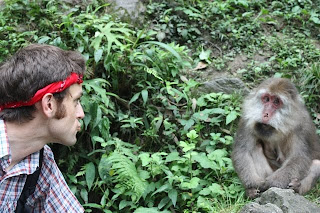
We approached the so-called joking monkey toll zone, (Tibetan Macaques, technically) so named because its swarming with monkeys (and Chinese tourists), and the monkeys block your path and you have to give them something to get past. For the most part though, they were fat, lazy and sated by the tourists feeding them, so we got our pictures (you can get right up next to them), and progressed onward and upward, away from the monkeys and away from the tourist hordes. Upward we went- the ascent getting more intense, with regular 500 stair ascents with no landings and a few monkeys here and there, or the occasional snack stand offering water, red bull, tomatoes, cucumbers and all manner of fungus. Finally we came to a flattersection, and a monkey stopped in the path in front of me. I rapped my monkey stick on the ground (my bamboo hiking pole that we'd taking to calling our "Hellz Wind Staffs." Nothing, he just stared back at me. "Hey Ben, check out how fearless these monkeys are!" I shouted up, and looked back down he was gone. Suddenly, a weight on my back. Shit. I turned and could barely make out a furball on my backpack. "AAAAGH!" I started spinning backwards in circles, frantically (and very, very awkwardly) swatting at my pack with my bamboo stick. It was all rather slapstick and I must have looked like Chevy Chase in Chinese Vacation if there were such a thing, though I was also having a hard time standing up- not just off balance from the monkey on my back but laughing so hard at the absurdity of it and how I must have looked. He didnt let go either- not until he'd gotten into the backpack and extracted my bag of peanuts I'd been saving for later did he leap off. He stood there staring at me, peanuts in hand. I took a step forward, he bared his teeth and hugged the peanuts closer. I attempted to bare my teeth back, but even though I never had braces, my teeth are not very scary. Okay my simian friend, you've won this round fair and square. Besides, the peanuts here are stale and always dusted with MSG. (as it everything- yes, thats the secret to Szechuan cooking- and they even give you a dish of it with your meal to season your food a little more should you so desire.)

Monkey episode behind us, we pushed onward, on the lookout now for monkeys and food more securely stored in our packs. The fog was coming in thick, and I could barely see Ben ten paces ahead. We found the next monastery by literally walking into it- and it was quite beautiful and dramatic in the fog, the sound of gongs and sweet smell of incense that we couldnt see, pagoda roofs sliding in and out of the fog... very cinematic. We rested for a while but a good sized tour group came up behind us, and we decided to press on to Yuxian, the next monastery seven or eight kilometers up the path.

An hour or so later we arrived at the dramatic clifftop Yuxian temple, where we checked in with a grumpy young monk who kept a slingshot for monkeys tucked into his robe, and mostly sat around smoking cigarettes and watching kung fu movies. (educational movies perhaps? After all, Emei Shan is purportedly where the Shaolin martial arts style originated. And by the way, there is ALWAYS a kung movie drama on TV here!). The views were dramatic, and this place too was literally crawling with monkeys and monkey families, dozens probably that would keep running into the temple, the kitchen, the hallways, and were admittedly quite cute in spite of my newfound monkey paranoia.

A decent night's sleep and an extremely bland monastic breakfast and we were up early for more insane stair ascents through the fog in the quiet of the morning and up to the elephant bathing pool temple, where we paused and looked out over the other mountains- the other temple-topped peaks poked out of the fog like islands floating in the clouds, a really incredible sight like out of an old Asian painting. We paused for some pictures and a break and pressed onward, listening to the sounds of the forest, the streams running and... honking horns? We heard the parking lot just below the summit before we saw the dozens of behemoth buses belching out diesel and letting off seemingly thousands of tourists. It was a similarly dispiriting feeling I had climbing Mt. Washington- up early to hike, only to arrive at a parking lot of folks who'd driven it and were just looking for souvenirs and bumper stickers. We pushed through the crowds to the trail the last few kilometers to the summit, which was clogged with new tourists, those who werent taking the gondola the rest of the way, and the last few steps hindered by demands by schoolgirls that we get in pictures with them- (really should start charging for these!) And ultimately the summit was pretty spectacular, a massive gold Buddha and temple crowning the dramatic peak with some phenomenal views. Lunched at the summit and decided to stay up there as well, and awoke early the next morning for a somewhat disappointingly cloudy sunrise before heading down. And about ten steps down the clouds broke, and I mean, seriously broke- within minutes the stairs were transformed into rushing two inch deep rivers and waterfalls as we scrambled to the lower summit to find a bus in the parking lot we'd been disparaging less than a day before. But boy was that ride home in the rain sweet, even though my clothes are still drying a day later.

So its back in Chengdu now, a few more days in China for Pandas, Bamboo and hopefully some more interesting culinary adventures. Probably one more email before I head home Saturday. Meanwhile, thanks for reading and really looking forward to seeing everyone next week! By the way, great NYTimes article about contemporary Tibet here...

Friday, July 23, 2010

Hello Dali, Goodbye Kunming, (Hello Chengdu)

Starting this email on my iphone while sitting on the side of the road waiting for the bus to Dali to get going again. Dali being the next overtouristy "traditional" old Chinese town on the trail south. By overtouristy I generally mean overpopulated with Chinese tourists not Westerners. Lijiang was lovely, in spite of the rain (flooding apparently washed away a few towns and people with them here in the past few days), and I highly recommend the Panba hostel, in spite of its inexplicable Christmas themed decorations- (we had a Merry Christmas stocking hanging on our door- perhaps we are close to the factory?)

Yes, our bus is not broken down, but once again, something has happened in the distance and we are stuck waiting. So I realize I've written a lot about the driving here, and i relize also that there are certain unfortunate stereotypes about driving out there that I don't want to perpetuate, but I will say that there are unique qualities to road travel in a country where 95% of the drivers learned to drive in the past five years. For example, heading out of town in a taxi to the bus station (in a car whos brand uses the starfleet/ star trek logo), we drove on a three lane road- no, not three lanes in either direction, just three lanes with white dotted lines. Our taxi to the bus station took us down a terrifying but not atypical three lane road- sort of a lane for one direction, sort of a lane for the other, but most cars, including ours seemed to prefer swerving in and out of the middle lane, feinting left and right at oncoming traffic like some insane video game. We talk in America about cars being an extension of ourselves, and its true here, but people drive the way they walk- a line is more like a funnel shape, and occasionally someone will be just stopped at an intersection reading a newspaper as we saw yesterday.

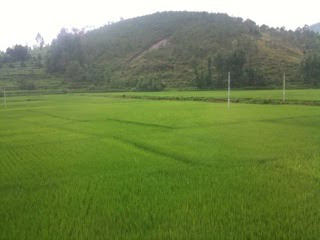
Secondly, without exaggeration and without exception, every single busride of over two hours has resulted in waiting for well over an hour for the bus to wait for an accident. Sometimes a minor fender bender, often a truck or bus gone over the side. And you just wait, meanwhile, police appear, sirens blazing, but only seem to have on their sirens to get PAST the accident, not resolve or help with the issue by exercising any kind of authority whatsoever that could speed things up. Eventually, some settlement is reached, perhaps by the crowd who stand aroud taking pictures and watching and contributing to the debate of fault. Of course, when one lane of traffic stops, the traffic in that direction merely crosses the line and doubles up both sides of the road, resulting in miles of cars and buses backed up in either direction again taking up both sides of the road with both directions of traffic. At least today we are waiting in a scenic rice paddy. Ah, and moving again, and now that the movie has ended, the bus is now showing Karaoke videos, which the passengers thankfully are (mostly) not singing along with.

Anyway, now in Dali, aka Xiaguan, an "ancient" town on the shores of a lake with some holy 1000 year old pagodas nearby. I have to say, these towns are starting to blend together like the Unesco-fied colonial cities of Latin America. Beautiful to be sure, but we are ready to do sonethong else pretty soon. I have to say though, although tourist, Dali is less touristy than Lijiang and Shangri-La, and more oriented toward western tourists than Chinese ones, and feels a little down at heels/rough around the edges which lends it some authenticity that I like. Either that, or its a little more friendly and familiar to me as a Westerner, and its nice to get a decent cup of coffee and even, yes, a slice of cheesecake. We checked out the temple in the rain (Which has not let up in what feels like weeks), which in the rain and fog, bore little resemblence to the photo attached.

With the rain, we only stuck around Dali for a day and headed out by bus for Kunming, a small Chinese city of a few million in Yunnan. The trip started well on the expressway, past traditionally dressed women harvesting their rice paddies as they have for millenia seemingly oblivious btoy the sudden sprouting of an expressway in the middle of their rice paddy. But soon we were off the expressway and going very slowly chugging up nearly washed out dirt roads pocked with craters. We were moving along decently until gradually things slowed and then heart sinking feeling as the bus shuddered and the engine shut down, just before nightfall. A few more hours waiting on and off the bus as the sun set on the side of the road, walking up and down past villagers, and Chinese texting, eating and chatting and a makeshift casino where men were shouting in Mandarin- with cigarettes and cards in one hand and fistfulls of Yuan in the other. I have to admit I was starting to grow suspicious, given that the villagers had a strong economic incentive to cause breakdowns given the money they were making selling tea eggs and boiled corn. During the wait we even watched a local set up some logs, stretch a tarp over them and start boiling water, making soup and setting out benches. In our hunger by midnight we found ourselves busily slurping soup with dozens of other Chinese denizens of the makeshift restaurant. Finally a ways after midnight we were moving again, but not before the passengers of whichever bus had broken down had piled into ours. Note to all planning to travel by bus in China- don't forget to pack four meals, three books, a headlamp, raincoat, pillow, tent, extra money and hopefully a strong bladder- be like the boy scouts, be prepared...

Kunming was pouring with rain when our bus pulled up at three AM along with every other bus that had been stuck in the same traffic. Cab competition was predictably fierce but manages to get one to the weird Chinese hotel that our last hostel had booked for us. We arrived and fell immediately to sleep, waking up the next day to discpver that our hotel room was on the 8th floor of an anonymous skyscraper and our room was next door to various business offices- the hotel rooms seemed to alternate with office suites and apartments. With no clue where in this giant city we were, we successfully navigated ourselves from filled up hostel to filled up hostel until we decided to just leave our bags at the Hump Hostel- Kunming's primary megahostel, and try to get train tickets OUT of Kunming. The station, while not more insane than Indian rail stations, was impressively insane and of course entirely in Chinese and no foreign ticket office as in india. We tried waiting in a few different lines as we attempted to decode the Chinese characters on the schedule boards, only to deduce that the next three days worth of trains to Chengdu were sold out. A plane ticket was a no brainer though, at less than $100 and less than an hour, compared to 60$ and twenty-two hours. See you later Kunming.

But not before we attempted to find the comforts of home in this foreign city. We wandered in the worst rainstorm I've been in since Cambodia in '06, around Kunming's answer to Times Square, made ourselves sick on Big Macs and attempting to take in an American movie. After much pointing and then photographing and showing the picture of the movie we wanted to see, we settled into the air conditioned theater. A few Chinese subtitles popped up in the credits and we relaxed, looked like not dubbed but subtitled. Until Tom Cruise starting speaking Mandarin and we began wondering if the movie was dubbed into Mandarin with Cantonese subtitles. Oh well, we killed enough time to beat the rain and escape to Chengdu that night, the largest city in Szechuan provence.

More on Chengdu, its amazing food and its charming whitish yellow air in a few days. We are currently in Emei, site of a holy buddhist mountain which we will be climbing for the next few days while crashing in monasteries. Hopefully the smog won't kill us here either!

And I don't mean to sound so negative- the trip remains quite a memorable adventure, in spite of some illness and travel difficulties. Still, looking forward to getting home and seeing everyone and acting like an incorrigible snob about Szechuan food!

PHOTOS: Rice Paddie where bus broke down, Dali, Dali...

Sunday, July 18, 2010

Lijiang is Gorges or How I Learned to Love Commie Naxis and Wu-Tang Cola

Arrived in Lijiang a few days ago and checked into a great hostel (Panba!) after some linguistic confusion (two person room, not two person bed). True to the word of other backpackers we encountered, its at least as touristy here as in Shangri-La, but way less artificial feeling. Lijiang has one of those old towns that you would think exists only in our imagination about ancient China - traditional pagoda roofed buildings, flagstone streets, old canals rushing water between the streets. Strolled the alleyways and backstreets eating some random street food, the whole place has canals and bridges and views of Jade Dragon Mountain and is reminiscent, for me, of Hoi An in Vietnam, though somehow now quite as charming, but still, quite charming.

Tiger Leaping Gorge is apparently THE trek to do in Southern China- China in general for that matter. I was ready for a little bit of hype, but the place exceeded my expectations and then some for a pleasant surprise. The gorge is so nam
ed for a legend about a tiger leaping across it or something, which strikes me as unlikely, but still. Unfortunately, the fact that it lives up to the hype also means that the local government is furiously planning hotels, golf courses and theme parks. For now however, it remains unspoiled. We headed out in the rain unfortunately, and day one was mostly up- the 28 bends (switchbacks) to be precise and about 6 miles or so to the guesthouse at the halfway point. Only an hour or so in however, we were pleased to see a sign reading "halfway." A few minutes later, another sign reading halfway. Okay, well, maybe its approximate. A good deal later, another sign, and we realized that it was an advertisement for the amusingly and unironically named "Halfway House" guesthouse. Upward we pushed through the rain, c
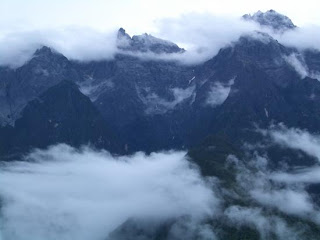
lambering up the clay trail, and pretty easily passing the few other gringos on the trail, slowed by hangovers and their constant cigarette breaks. Local kids with donkeys followed us much of the way, asking if we were interested in renting a donkey, but we were doing okay. Almost lost the trail a few times, but the one good thing about the donkeys was that the trail could always be found again by following your nose or eyes back to the donkey shit. And in spite of the rain, or perhaps because of the clouds and mist, the views were spectacular across the Yangste roaring below and over to the mountainous cliffs on the opposite side of the gorge. Thousand foot waterfalls pouring down sheer cliffs, mist forming and unforming around the mountains, the nearest description I can make (lame reference alert) was that this place was clearly the inspiration for the hanging mountains of Pandora from Avatar. But real. After an hour and a half we made it over the 28 bends and through a villages to the Halfway House. That place too had the most spectacular view I've about ever seen in my life, looking out across the gorge. The place itself was incredible Swiss-Family-Robinson-Esque place that even had hot showers and great food. Spent the evening shooting the shit, in fact, having the most ridiculously utter nonsense conversation with an Irishman (my favorite of the anglophone travellers) and the drollest Dutchman, and just spent a few hours laughing and swapping stories.

This morning, after a great night's sleep, we headed out again ambitiously for the next town. A clear but slightly misty day, we traversed through ancient Naxi tribal villages with stone walls and those pagoda-y, Chinesey looking roofs, terraced farms cut into the mountain, past goat-herders and wild horses, over waterfalls and through bamboo forests and down through a... marijuana field? Wait a minute- you don't need to have read The Beach to know that when you stumble onto someone's private marijuana patch in Southeast Asia you have definitely gotten yourself lost. And lost we were, doubling back, tripling back, running out of water, stumbling through farms to find villages that seemed completely empty we were starting to lose steam. Finally we pantomimed to some peasants tending their pigsties who pointed us one way, and stumbled into another farm where the girl there spoke enough English to say "This way road!" Well, basically we crashed our way down the gorge and to the low road where we caught a van and picked up a nice young couple who'd gone to Brown and even knew a few people in common. Drove about ten minutes until we reached a point where the new road was covered in rubble from a dynamite blast we'd heard a few minutes before. And by rubble, I mean gigantic boulders that a front end loader was busy clearing away. While we watched. For another hour. As the rain began. But soon enough we were on our way, swapping travel and America stories with Nate and Emily, and learning about his great iphone app (pleco- check it out) that translates characters that you draw on the touchscreen instantly into English, or at least into amusing Chinglish. It is a GREAT way to pass time in traffic jams... We also learned some great phrases that we tried out on our poor driver, including the wonderfully onomonopaetic "oo-uhh" which means "to vomit." And the other delightful piece of Mandarin? Wu-Tang means sugar-free. So if you want a diet coke in Beijing, order a "Wu-Tang Cola."